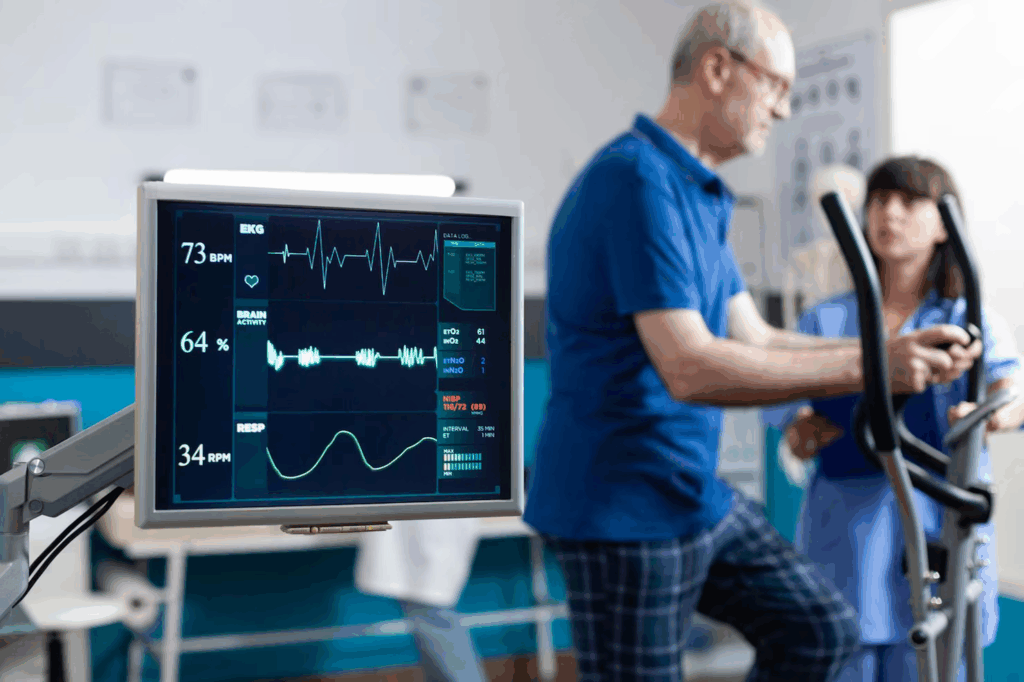
The procedure is supervised by trained cardiac staff at all times. You’ll be asked to report any chest discomfort or breathlessness so the test can be adjusted or stopped if needed.
Exercise Test (Treadmill or Exercise ECG)
An exercise test — also known as an exercise ECG or treadmill test — measures how your heart responds to physical activity. During the test, you will walk on a treadmill (or occasionally cycle on an exercise bike) while your heart rate, rhythm, and blood pressure are continuously monitored. This allows your cardiologist to see how well your heart functions under controlled physical stress and whether it receives enough blood and oxygen when working harder.
Why is it performed?
An exercise test is often recommended to investigate symptoms that occur during exertion, such as chest pain, shortness of breath, or palpitations.
It can help identify reduced blood flow to the heart muscle (which may suggest coronary artery disease), assess how well current treatments are working, or evaluate your heart rhythm and fitness levels during activity.
In some cases, it is also used to monitor recovery following a cardiac procedure or to guide a safe and effective exercise programme as part of your ongoing heart health management.
What does the test involve?
Before starting, electrodes (small adhesive pads) will be placed on your chest to record your heart’s electrical activity, and a blood pressure cuff will be fitted to your arm.
You’ll begin walking at an easy pace, and the speed and incline of the treadmill will increase gradually every few minutes to raise your heart rate in a safe, supervised manner.
Throughout the test, trained cardiac staff will monitor your heart rhythm, blood pressure, and symptoms, and you’ll be asked to report any chest discomfort, breathlessness, or dizziness.
- Preparation & Positioning
Wear comfortable clothes and shoes suitable for walking, and avoid a heavy meal before your appointment. Electrodes will be placed on your chest and a blood pressure cuff fitted to your arm.
- During the Scan:
You’ll walk on a treadmill that gradually increases in speed and incline while your heart rhythm, rate, and blood pressure are closely monitored. The test typically lasts 10–15 minutes.
- Safety & Comfort:
After the test
Once the treadmill stops, you’ll rest for a few minutes while your heart rate and blood pressure return to normal. Most patients feel fine afterwards and can return to work or home immediately.
Your cardiologist will review the results carefully and explain whether your heart showed any signs of reduced blood flow or abnormal rhythm during exercise.
These results help guide further tests, treatment, or lifestyle recommendations to support your ongoing heart health.