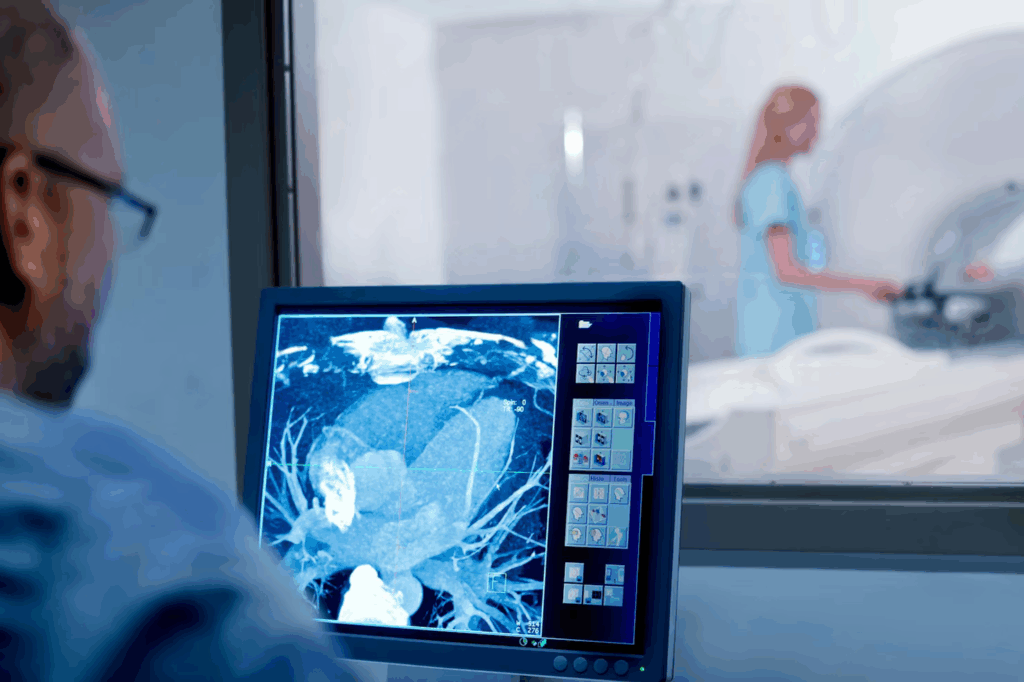
In addition, a cardiac CT can be used to examine the heart’s structure and valves in detail, especially before certain procedures such as TAVI (transcatheter aortic valve implantation), or to help diagnose congenital heart abnormalities like an atrial septal defect (ASD).
Overall, this scan offers an accurate and non-invasive way to evaluate your heart’s health, helping your cardiologist make well-informed decisions about your care and treatment.
Cardiac CT (CT Coronary Angiogram) or CT calcium score
A cardiac CT scan uses advanced X-ray technology to produce detailed, high-resolution images of your heart and its blood vessels. This allows your cardiologist to clearly see the heart’s anatomy, including the coronary arteries, which supply blood and oxygen to the heart muscle. The scan provides an accurate and non-invasive way to assess heart health and detect potential problems early.
Why is it performed?
A cardiac CT scan is carried out for several important reasons. It helps detect and assess conditions that affect the heart and its blood vessels, providing your cardiologist with detailed information that cannot be obtained through other routine tests.
One type of scan, known as a CT calcium score, measures calcium deposits within the coronary arteries — a key indicator of heart disease risk and a useful tool for predicting the likelihood of future heart attacks. Another common type, the CT coronary angiogram, is used to check for narrowing or blockages in the arteries that supply blood to the heart, particularly in people experiencing chest pain or who have risk factors for coronary artery disease.
What does the test involve?
You’ll lie on a comfortable scanner bed that moves slowly through a doughnut-shaped CT machine.
Small electrode pads will be placed on your chest to monitor your heart rate during the scan. A contrast dye is usually injected into a vein in your arm to make the arteries and heart structures more visible.
You may be asked to hold your breath for a few seconds at certain times to capture clear images. The procedure is quick and entirely painless.
- Preparation & Positioning
You’ll lie on a scanner bed while small sensors are placed on your chest to track your heart rate. A contrast dye may be injected through a vein to make the heart and arteries clearly visible.
- During the Scan:
The scanner moves slowly around you, taking detailed images as you’re asked to hold your breath for a few seconds at a time. The procedure is quick, painless, and carefully monitored.
- Safety & Comfort:
The scan usually takes around 15–20 minutes and uses a very low dose of radiation. You can eat, drink, and resume normal activities immediately afterwards.
After the test
You’ll be able to eat, drink, and drive straight afterwards.
Your cardiologist will carefully review the images and explain the findings to you, including whether any further treatment or investigations are needed.
A cardiac CT is a safe, quick, and highly informative test that plays a key role in understanding and managing your heart health.