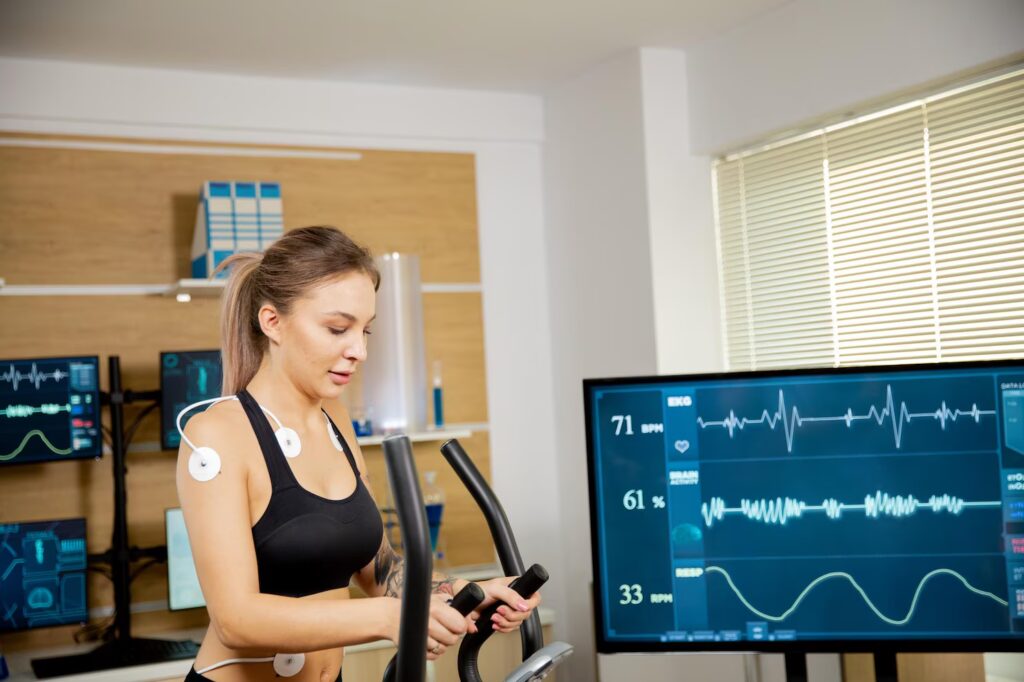
A standard echocardiogram (heart ultrasound scan) provides a great deal of information about the structure of your heart and how well it works when you are resting. However, some heart conditions only become apparent when your heart has to work harder, such as during exercise. If your symptoms mainly occur when you are active, a resting scan may not tell the whole story.
A stress echocardiogram helps us understand how your heart performs under these more demanding conditions. By looking at your heart while it is working harder, we can identify problems that may not be visible on a routine scan. This makes it an important test for investigating symptoms such as chest pain, breathlessness or unexplained reduced exercise capacity.
The stress echocardiogram: seeing your heart in action
A stress echocardiogram is designed to assess how your heart responds when it is under strain. Unlike a standard echocardiogram, which is performed while you are resting, this test allows us to see how your heart functions during exercise or after medication that makes it work harder.
The test begins with a series of ultrasound images of your heart at rest. These provide a baseline that can be compared with images taken later in the test.
Your heart is then put under controlled stress, either by exercising on a treadmill or by receiving a medication called dobutamine, which increases your heart rate and the strength of each heartbeat. Once your heart is working harder, another set of ultrasound images is taken.
By comparing the images before and during stress, your cardiologist can see whether all parts of the heart muscle are receiving enough blood and contracting normally. Areas that do not move as well during stress may indicate a narrowing or blockage in one or more of the coronary arteries.
Because the test uses ultrasound, there is no exposure to radiation. It is a safe, non-invasive investigation that provides valuable information about how your heart functions during everyday physical activity, rather than simply how it looks at rest.
Exercise or dobutamine: which is right for you?
For most people, the preferred option is to exercise on a treadmill. The speed and incline gradually increase while your heart rate, blood pressure and ECG are closely monitored. This provides the most natural way of assessing how your heart responds to physical activity.
However, not everyone is able to exercise enough to make the test accurate. Mobility problems, arthritis, lung disease or other medical conditions can make treadmill exercise difficult or unsuitable.
In these situations, we use a medication called dobutamine. It safely increases your heart rate and makes the heart beat more strongly, producing effects that closely resemble exercise. Throughout the test, you are carefully monitored by experienced healthcare professionals to ensure your safety.
Whichever approach is used, the aim is the same: to see how well your heart performs when it is working harder and to identify any problems that may not be apparent at rest.
What is the cardiologist looking for?
The main purpose of a stress echocardiogram is to identify areas of the heart muscle that do not receive enough blood during exercise or stress.
When the coronary arteries become narrowed by fatty deposits, blood flow may still be adequate while you are resting. However, when your heart has to work harder, those narrowed arteries may no longer be able to deliver enough oxygen-rich blood. As a result, part of the heart muscle may not contract as well as it should.
These changes, known as wall motion abnormalities, are one of the key signs that cardiologists look for during the test. By comparing the images taken before and during stress, we can identify these subtle differences and assess whether they are likely to be caused by coronary artery disease.
The test can also be used in some patients with narrowing of their aortic valve (aortic stenosis), when associated with weakness of the heart muscle. This can clarify how severe the aortic stenosis really is and whether it needs treating or not.
Your cardiologist will also assess how your heart rate and blood pressure respond during the test, as well as your overall heart function. Looking at all of this information together provides a much clearer picture of your heart health and helps determine whether further investigations or treatment are needed.
Rapid answers and faster diagnosis
One of the major advantages of a stress echocardiogram is that it can provide answers quickly. In many cases, your cardiologist can discuss the initial findings with you shortly after the test, helping to reduce the anxiety of waiting for results.
If the test suggests reduced blood flow to the heart muscle, further investigations or treatment can be arranged promptly. Early diagnosis allows us to manage coronary artery disease before it leads to more serious problems, such as a heart attack.
Many specialist cardiology clinics offer stress echocardiography as part of a streamlined, one-stop assessment. By combining consultation, imaging and interpretation into a single visit where appropriate, patients can often receive a diagnosis and management plan much sooner than through more traditional pathways.
If you have symptoms such as chest pain, breathlessness or reduced exercise tolerance, a stress echocardiogram may provide the answers you need. An early assessment can help identify the cause of your symptoms, guide the most appropriate treatment and give you greater confidence about your heart health. Schedule an appointment to receive expert guidance tailored to your symptoms and concerns or contact your GP.